How I Built a 5 App Portfolio as a Student (to $10K/Month)
5 mobile apps, $10K MRR at peak, built with ASO, Apple Search Ads, and TikTok Ads. What worked, what flopped, and the real numbers behind each app.
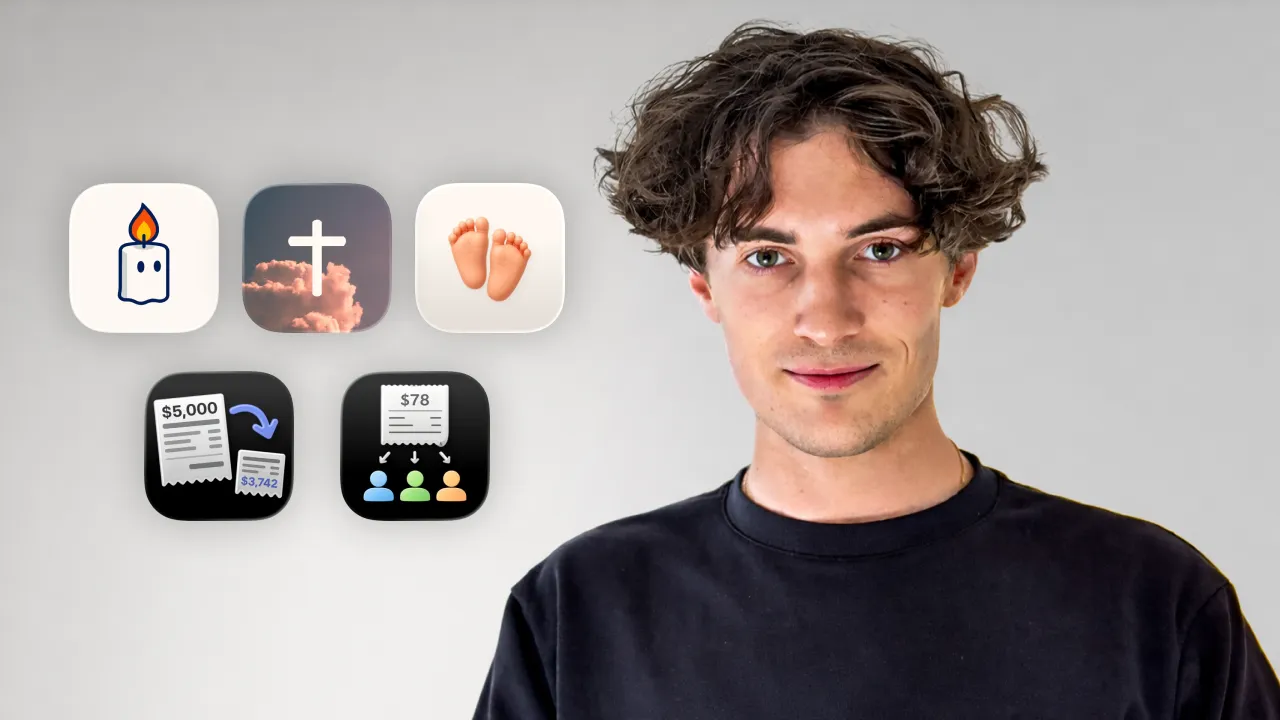
I'm Arthur Spalanzani. I'm 22, I'm a student in France, and I build mobile apps. 5 apps shipped: Versy, Glow, Lua, NetPay, and Divvy. $10K MRR at peak with low ad spend, so most of that was actual profit. This is the full breakdown of what worked, what flopped, and the real numbers.
How to pick a profitable niche for a mobile app
Five apps, from best to worst: Versy (bible app), Glow (affirmations app), Lua (pregnancy tracker), NetPay (salary calculator), and Divvy (bill splitter).
None of them solve a hard technical problem, and that's the point. The simplest products made the most money. Single-featured apps that I could build fast and start distributing right away. I wanted apps where distribution was the game, not engineering.
The way I picked niches was simple: look for categories with a lot of money and downloads, where the top revenue is spread across multiple apps. I avoided niches where one app grabs 80% of the revenue because that usually means they've already figured it out and there's no room for you.
No fancy frameworks for picking ideas. You can filter out bad ones with some upfront analysis, but the only real way to validate a good idea is to ship it and see what the App Store data tells you.
How to grow an app with TikTok Ads
Glow was my first real experiment. An affirmations app I built in public on YouTube.
I grew it with TikTok Ads only. Apple Ads didn't work for this one. I started with Smart+ campaigns without an MMP (mobile measurement partner), then added one to send events back to TikTok's algorithm so it could optimize better. In the video I was only optimizing for downloads, but I later learned that optimizing for deeper events like "trial started" or "onboarding finished" works almost always better. The algorithm finds higher-intent users when you give it a stronger signal.
For creatives, I created a fresh TikTok account and trained the algorithm to show me what my target audience was already watching. Whenever I spotted an ad format that seemed to convert, I'd replicate it. At first I tried posting creatives organically and only promoting the ones that got traction, but I found it faster to test them directly as ads and kill the losers quickly. Once a format worked, I'd double down on it. Make small variants of the hook, squeeze as much out of that format as possible before moving on.
The problem was ad fatigue. Ads stopped working after a few days and I had to produce a ton of content to keep up. The niche was super saturated too. Glow made money but I knew I needed something better.
How to optimize onboarding to convert more trials
Versy was born from Glow's mistakes. Same codebase, different color theme and onboarding flow.
This time I did everything differently.
I started with analytics first. I'd read RevenueCat's State of Subscription Apps 2026 report that says 80% of conversions happen during onboarding. So that became my only focus.
I released the app, got the App Store boost, got trials, the signals were good. Then for the next few weeks I spent small amounts on Apple Search Ads just to get traffic, and iterated on everything: price points, trial duration, onboarding flow. It took time, but I got my onboarding conversion rate to around 25%.
How to rank an app on the App Store with ASO
I localized Versy in countries I thought could be good markets. I worked hard on ASO, doing all the tricks to rank as high as possible (that's actually why I ended up building AppSprint ASO, my ASO tool).
I also added review prompting during onboarding to collect as many reviews as possible. Currently at 400+ (4.7 avg) worldwide. Ratings are the single most important factor for ASO rankings on the App Store.
Then I iterated on the app icon and screenshots to improve my Apple Search Ads conversion. Landed on 80% conversion rate from impression to tap. That's when I knew the store listing was dialed in.
How to use Apple Search Ads profitably
Once the onboarding was solid, I focused Apple Ads on Brazil and LATAM countries with prices adjusted to local purchasing power. Conversion rates went crazy.
But I hit the Apple Ads wall. I was profitable on some exact match keywords, but couldn't get enough volume because not enough people were searching for them. And I didn't want to spend on keywords that weren't profitable. That's the tradeoff with Apple Search Ads: you don't need to create content, but you can only capture existing search traffic. You can't create demand.
I also used Apple Ads to validate the ASO keywords I found with my ASO tool. Apple Ads is the only real source of truth for keyword performance. Always check your search queries to understand what's actually driving traffic, because a keyword that looks great on paper might not convert for your specific app. Maybe it doesn't match your screenshots, or it attracts the wrong audience. This was especially true for me in Brazil since I don't speak Portuguese. I couldn't trust my gut on keywords, only the data.
How to rank in the US App Store from any country
NetPay and Divvy were my last two experiments. Pure ASO plays. I targeted the US using the localization matrix, which means setting US keywords in countries that also rank in the US App Store:
en-US (🇺🇸), pt-BR (🇧🇷), es-MX (🇲🇽), fr-FR (🇫🇷), ar-SA (🇸🇦), ru (🇷🇺), vi (🇻🇳), ko (🇰🇷), zh-Hans (🇨🇳), zh-Hant (🇹🇼).
It's basically a hack to boost your US rankings.
Both apps were vibe coded in 2 hours each. Simplest possible versions. Single screen, simple onboarding, simple paywall: weekly at $5 with 3-day trial or yearly at $20.
Divvy (bill splitter) gets about 100 downloads per month. Failed.
NetPay (salary calculator) gets a few trials per week fully organically. No ads, nothing. A few conversions, mostly weekly subs. Weekly subscriptions make surprisingly good money compared to yearly. Not a big earner, but pure profit since I spend nothing on it.
Does TikTok organic work for app growth?
Not really. I ran multiple accounts, got decent views, but the whole process was painful. Creating US accounts, warming them up, getting banned, using a spare phone. I got some traction but never anything consistent. I think I'm just better at paid than organic. Paid is predictable. You put money in, you see what comes out, you optimize. Organic felt like guessing every time.
Should you launch your app on Android?
I published both Glow and Versy on Android. No traffic. So I tried Google Ads. My bible app got restricted for religious content and my CPI was really high. Same for Glow, even after spending a lot and testing different approaches.
From my experience, Android shouldn't be your priority. You earn less per user. But there are still huge opportunities there, I just didn't spend enough time to figure it out. The developer account is way cheaper than Apple's, and you'll make your money back for sure. If you have free time, go for it. Otherwise, spend that time optimizing your onboarding and store listing on iOS first.
Why I failed with my pregnancy tracker app
Lua got a huge App Store boost. 20 trials started, zero conversions. I spent a lot of time iterating, trying to get it to convert. Made a few hundred bucks but nothing real.
I also tried Instagram organic. I launched an account and posted a simple format that went viral. 1.4 million views in one week. Sounds amazing, right? The conversion to downloads was terrible. Two reasons. First, the app name wasn't showing up as the first result when people searched for it on the App Store. Basic mistake. Second, about 30% of the audience was from India, so even with massive views, the purchasing power wasn't there. Millions of views, almost no revenue.
On top of all that, I'm not a woman, I've never been pregnant, and I was bad at understanding my customers. Lost motivation and moved on.
What's the best acquisition strategy for mobile apps?
Paid acquisition + ASO. That's what worked best for me.
ASO gets you organic rankings. Paid ads (Apple Search Ads, TikTok Ads, whatever works for your niche) get you volume. Together they compound. I'd say spend most of your time on the onboarding and the store listing (icon + screenshots), not on building features. A 25% onboarding conversion rate matters way more than a fancy new feature nobody asked for.
What I'd do differently if I started over
Skip the niches where I can't understand the customer. The pregnancy app taught me that. Start with analytics from day one instead of adding them later. And focus on one app at a time instead of spreading across five. Versy got the most attention and performed the best. Not a coincidence.
I'd also validate the ad channel before building the app. If I can't figure out how I'll get traffic, I shouldn't build it.
You might also like
See all case studies →
I Built a €1M/Year Dating App in 4.5 Months
Gabriel Zeitoun explains how BPM reached €1M in annualized revenue in 4.5 months through a run club, premium features, and Meta ads in France.
I Built a $300K/Month App Business With UGC
Enzo explains how he built a $300K/month app business with UGC creators, 250M monthly views, repeatable formats, and performance-based pay.
I Got 1 Billion Views For My App With No Ads
Mauro Botanes explains how Symmetry reached $200K/month, 2M downloads, and nearly 1B organic views by building a creator machine instead of running ads.